Showing posts with label Amazing. Show all posts

The theme park's 'cage of death' that drops tourists into a crocodile's lair

Without the cage you wouldn't stand a chance swimming with a massive saltwater crocodile. But for brave punters who still want to get cosy with a feisty croc, a new Australian tourist attraction is offering the chance for a close encounter in the safety of a clear acrylic box dubbed the 'cage of death'.

Just 4cm of acrylic, a pair of goggles and a swimsuit, will separate thrill-seekers from the jaws of Choppa, a saltwater crocodile. Close encounter: A tourist dives into a cage partially immersed in a crocodile pen at Crocosaurus Cove in Darwin, Australia. The cage has no bars, unlike cages used in shark dives, which prevents the reptiles from gripping on but deep teeth scratches are visible on the sides, deterring some hesitant participants.
Top End tourists climb into the clear box before being lowered into Choppa's lair. They then spend 15 minutes inside the 9ft high cage and watch Choppa, who lost both front feet while fighting other crocodiles, trying to take a bite out of them.
Getting cosy: Choppa the crocodile looks like he's 'affectionately' trying to hug the dare-devil tourist. The attraction at Crocosaurus Cove in the heart of the city of Darwin in the Northern Territory has been given high marks by adrenaline-junkies. 'This is it!' said self-confessed thrill-seeker Mark Clayton from Darwin after spending 20 minutes face-to-face with the crocodiles. 'I dive with sharks, large rays, moray eels ... But it's not this close. It's exhilarating to get that close to a crocodile of that size.'

Face-to-face: The experience is made even more thrilling for tourists because the cage has no bars Saltwater crocodiles, known locally as "salties," are the largest crocodile species, with the males growing up to 19.6ft long and weighing up to 2,204lbs.

They are found in across Southeast Asia but the highest numbers are found in northern Australia. Michael Scott, who opened the attraction in July, said there was plenty of demand for the £35 thrill. 'In the Northern Territory, the saltwater crocodile is an icon and is part of our life. They are always in the news, either in someone's swimming pool or killing someone's favourite horse,' Mr Scott said.
Hunting for food: Up to two people are allowed in the cage at the one time the most famous crocodile to be housed at the park is Burt, who starred as the beast that nearly ate Linda Koslowski's character in Crocodile Dundee. Although saltwater crocodiles are dangerous, fatal attacks on humans are rare in Australia with only one or two reported a year. Warning signs are displayed at rivers, lake and beaches in areas inhabited by crocodiles.
Dicing with danger: Swimming face-to-face with a massive saltwater crocodile might not be everyone's idea of fun but thrill-seekers are snapping up Australia's newest tourist attraction the most recent fatality was reported last month in Queensland when the suspected remains of a British man were found inside a crocodile. Arthur Booker, 62, was last seen checking crab pots on a crocodile-infested river in the state's north.

Rice fields of Japan ... amazing!

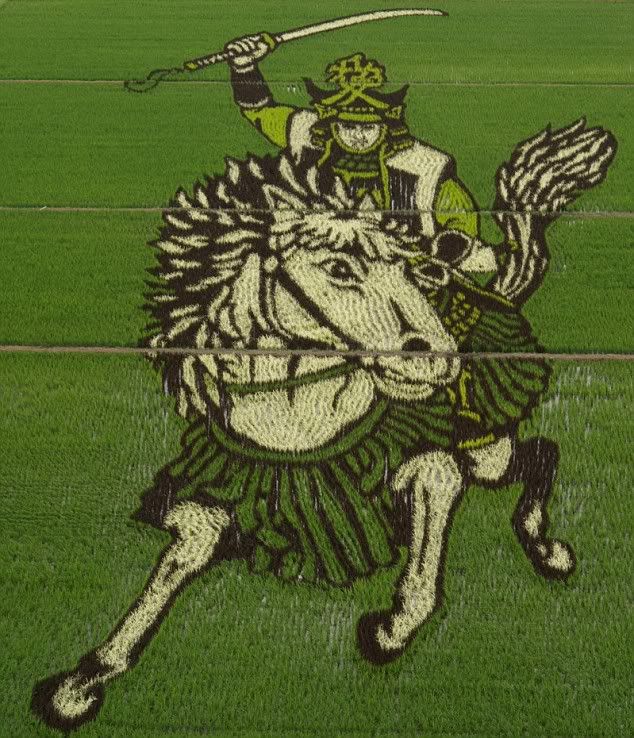
Stunning crop art has sprung up across rice fields in Japan. But this is no alien creation - the designs have been cleverly planted. Farmers creating the huge displays use no ink or dye. Instead, different colours of rice plants have been precisely and strategically arranged and grown in the paddy fields. As summer progresses and the plants shoot up, the detailed artwork begins to emerge.
A Sengoku warrior on horseback has been created from hundreds of thousands of rice plants, the colours created by using different varieties, in Inakadate in Japan. The largest and finest work is grown in the Aomori village of Inakadate, 600 miles north of Toyko, where the tradition began in 1993.
The village has now earned a reputation for its agricultural artistry and this year the enormous pictures of Napoleon and a Sengoku-period warrior, both on horseback, are visible in a pair of fields adjacent to the town hall. More than 150,000 vistors come to Inakadate, where just 8,700 people live, every summer to see the extraordinary murals.
Each year hundreds of volunteers and villagers plant four different varieties of rice in late May across huge swathes of paddy fields.


Napolean on horseback can be seen from the skies, created by precision planting and months of planning between villagers and farmers in Inkadate. Fictional warrior Naoe Kanetsugu and his wife Osen appear in fields in the town of Yonezawa, Japan. And over the past few years, other villages have joined in with the plant designs.
Another famous rice paddy art venue is in the town of Yonezawa in the Yamagata prefecture. This year's design shows the fictional 16th-century samurai warrior Naoe Kanetsugu and his wife, Osen, whose lives feature in television series Tenchijin.

Various artwork has popped up in other rice-farming areas of Japan this year, including designs of deer dancers.
Smaller works of crop art can be seen in other rice-farming areas of Japan such as this image of Doraemon and deer dancers. The farmers create the murals by planting little purple and yellow-leafed kodaimai rice along with their local green-leafed tsugaru roman variety to create the coloured patterns between planting and harvesting in September.
The murals in Inakadate cover 15,000 square metres of paddy fields. From ground level, the designs are invisible, and viewers have to climb the mock castle tower of the village office to get a glimpse of the work.
Rice-paddy art was started there in 1993 as a local revitalization project, an idea that grew out of meetings of the village committee.

Closer to the image, the careful placement of thousands of rice plants in the paddy fields can be seen.
The different varieties of rice plant grow alongside each other to create the masterpieces. In the first nine years, the village office workers and local farmers grew a simple design of MountIwaki every year. But their ideas grew more complicated and attracted more attention. In 2005 agreements between landowners allowed the creation of enormous rice paddy art.

A year later, organisers used computers to precisely plot planting of the four differently colored rice varieties that bring the images to life.

Oh !!! Shit


Pics that u will love..

SEE


Invite your mail contacts to join your friends list with Windows Live Spaces. It's easy! Try it!

The Air Show